Every week, Â鶹ÊÓƵ seeks to understand how people move the Naira in and out of their lives. Some stories will be struggle-ish, others will be bougie. All the time, it’ll be revealing.
What’s your earliest memory of money?
When I was in primary school, my dad unexpectedly pulled me out of public school and enrolled me in a private one. It may have been because he got a new job at a company with a staff school. Also, I think he saw my academic potential. I have five siblings, but I was the only one who switched to private school. Even as a child, I could tell that the school fees were extremely high compared to his salary.
The switch was the first time I realised that some people have significantly more money than others. Suddenly, I was surrounded by rich men’s children. Their parents drove them to school, and their pocket money was on a completely different level.
What was the financial situation at home?
My dad was a driver, and my mum was a serial entrepreneur who sold everything from pure water and ice blocks to zobo and food. I remember her enterprises sometimes led to small fights because she’d return home late, and my dad didn’t like it. He wanted her to be a housewife, but she insisted on having her own money. She hated the idea of a woman having to wait for her husband “just to buy matches.�
We never lacked the basics. My dad was incredibly determined to provide. He was the type to buy a TV at home because I was constantly going to a neighbour’s house to watch TV. One time, I admired a neighbour’s toy gun, and he bought me a new one days later. I never had to focus on what we had or didn’t have because my parents provided for us.
When was the first time you did something to earn money?
I was around eight or nine when I started hawking pure water for my mum during weekends and long holidays. I didn’t have to do it; it just felt like a fun way to make money.
At the time, my mum sold pure water to people who hawked, so she was like our wholesaler. She would give me a bag of water, then, after selling out, I’d return the cost price to her and keep 100% of the profit.
I did this on and off until I got to primary five. The “big boy” in me awoke, and I became highly socially conscious. Remember, I was attending a private school with wealthy classmates, and I didn’t want to be known as the street hawker. So, I stopped completely and didn’t try anything for money again till I got into university in 2012.
Tell me about that
In uni, I started making money from writing. I’ve been writing since I was in primary school. You know, scribbling stories here and there. Then, when I got into the 100 level, I noticed that content was gaining traction in Nigeria, and people were getting on it.
So, I began applying for random writing gigs, website management, and blogging opportunities. I did much of it for free because I enjoyed it, until people noticed my skill and started randomly paying me. That’s when I realised there was money in this thing and began to take it seriously.
My first paid gig was managing an entertainment gossip blog. I had to rewrite and post 7 to 10 news stories a day while juggling classes.
How much were you making?
They paid me ₦30k a month. After a few months, it went up to ₦50k, and eventually capped at ₦70k. I wasn’t writing for just one blog, though. I was constantly applying online and also often got clients via referrals. In a good month, I was easily clearing ₦120k – ₦200k.
That seems like a decent amount of money for a student in 2012
It was insane. My tuition fee was only ₦15k at the time. I lived an incredibly soft life. My dad still insisted on sending me ₦1500 every week because he wanted to proudly say he fully trained his child through school without me claiming I had to fend for myself. I took it, but ₦1500 barely lasted two days, so my writing entirely funded my lifestyle.
I was so comfortable that I practically took care of two of my friends who were struggling to feed themselves. One of them was my roommate, so I bought all the provisions and foodstuff, and they handled the cooking. For my other friend, I was always buying them food, taking them out, and letting them pick whatever they wanted.
I was also very big on gadgets in school, changing my phone and laptop every three to six months. So yeah, it’s safe to say I lived a soft life in school.
Inject it. What about after graduation?
I finished in 2016 and went for NYSC in 2017. Right before leaving for camp, I landed an international client who paid a lump-sum amount of ₦1 million for a content development project. That was my very first million.
After the initial lump sum, the contract transitioned into a monthly retainer of around $100 (which fluctuated between ₦30k and ₦45k after conversion). Alongside that, I had two other local writing gigs paying ₦70k and ₦60k every month. In total, I was making close to ₦200k/month during my service year.
My Place of Primary Assignment was a village school. I never had to touch my ₦19,800 NYSC allawee; I saved the whole thing. I even left my NYSC ATM card at home and only saw the credit alerts. I would buy food in bulk, and fellow corps members would come to my house to eat. The school kids often gave foodstuff to other corps members, but they hardly gave me any because, according to them, “Uncle, you don’t need it na. You’re a rich man.�
I’m screaming. What did you do with all that saved allawee, though?
I used it to get an apartment because I didn’t want to return to my parents’ place. My dad had rented out one of the rooms in our small room-and-parlour apartment to stay afloat. He’d done that since I was in secondary school, and the whole family had been squeezed into a single room for years. Whenever I returned home from school, I had to sleep on a student mattress laid on the floor at the foot of my parents’ bed. I didn’t like the experience at all.
In 2019, a few months after passing out from NYSC, I gathered my savings of about ₦230k, added some money, and rented a mini-flat. The total package was ₦575k (including a year’s rent of ₦300k plus an extra three months’ upfront payment).
°Õ³ó±ðÌý is returning on August 22, 2026, in Lagos! Come learn from finance experts and industry leaders, and partake in unfiltered conversations about building wealth and diversifying your income stream in a country like Nigeria. Real stories, expert advice you can actually use, and a community ready to build wealth together. .
Were you still strictly freelancing at this point?
In the same year, I landed a full-time role at a news media company, earning about ₦83k/month. After the first year, my salary jumped to around ₦183k.
The job forced me to reduce the number of writing gigs I took on since I dedicated most of my time to work. I still took on occasional gigs, though. Then, in 2020, I got an opportunity to work with an international brand as a customer relations and communications person. This job became an additional hustle alongside my 9-to-5, and it paid in Euros based on the number of customers I attended to each month, with a minimum payout of €100. I didn’t even convert the money initially. I just let it pile up in my domiciliary account and lived entirely on my 9-to-5 salary.
In 2021, I left the media company to join a fintech company as content lead.
What was the pay like?
Around ₦310k/month after deductions. The pay was good, but the work culture was toxic. It got so bad that in 2023, I took a pay cut just to escape. I moved to another company as an account manager, making ₦250k/month.
Was the new job better?
It was worse. I lasted only four months there. I still had the Euro-paying gig, and I told myself, “I’m making significantly more money from this gig than from toxic 9-to-5 jobs that require me to wake up early and jump buses.� If I put in more time at the gig, I could make more in the comfort of my own home. So, I quit and decided to face freelancing.
Also, to celebrate surviving that corporate madness, I decided to reward myself. Remember the Euro income I hadn’t touched for years? I had about €3,000 in my domiciliary account. I emptied it and bought a car for ₦3.8 million. After the purchase, I was left with ₦300k to my name.
Wasn’t that a scary move? Going fully freelance often means an unstable income
I’ve always been a risk-taker when it comes to money. Also, I had this huge confidence in my professional network. I knew that if freelance work ever dried up, it would take only one or two phone calls to secure another job. Fortunately, I haven’t had to.
I still earn from the Euro gig to this day, and my income has only increased. I also have another steady freelance income, plus other small gigs that come in from time to time.
Can you break that down?
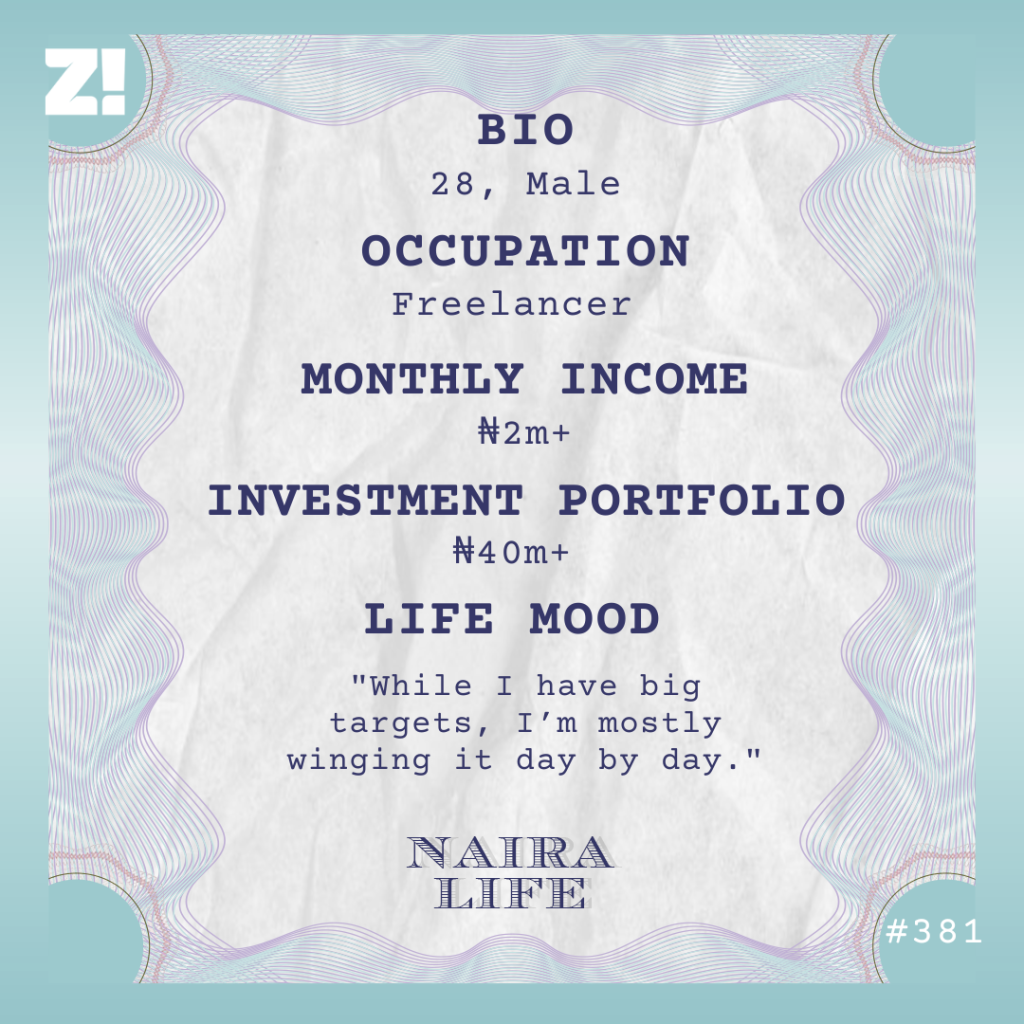
So, I have two main sources. The first is the Euro gig. The volume fluctuates, but it brings in between €2,000 and €2,500 per month. However, the workload became too much for me to handle, so I’ve been building a team over the last two years. I now have about seven freelancers working under me on a graduated scale. After paying them their shares (about 50% to 60% of what we make that month), I net roughly ₦1.6 million.
The second source of income is from my old client, who paid me my first million. We reconnected last year for a short three to six-month project, but it became permanent. I handle their communications, PR, and content strategy. It started at $800/month, but we renegotiated to $400/month (about ₦570k) since it’s long-term and continuous.
That’s over ₦2 million monthly
More or less. Some months can be a bit more since my main income isn’t fixed. I also get random gigs from time to time, which bring in extra income.
Also, you’ll notice that I’m now converting my income to naira. Now that I’m wiser, I realise how careless I was with money in the past. The €3,000 I used to buy my car had just sat in my account for two years, sitting idle and yielding nothing. Looking back, that was a big financial mistake. The money could have been turned into more if I knew what I know now.
I’ve worked on my financial literacy over the years, and I’m quite financially conscious now. I make sure that every single dollar or kobo that hits my account is funnelled into investments and assets that generate passive income. My money has to be working for me.
What does this look like in a typical month?
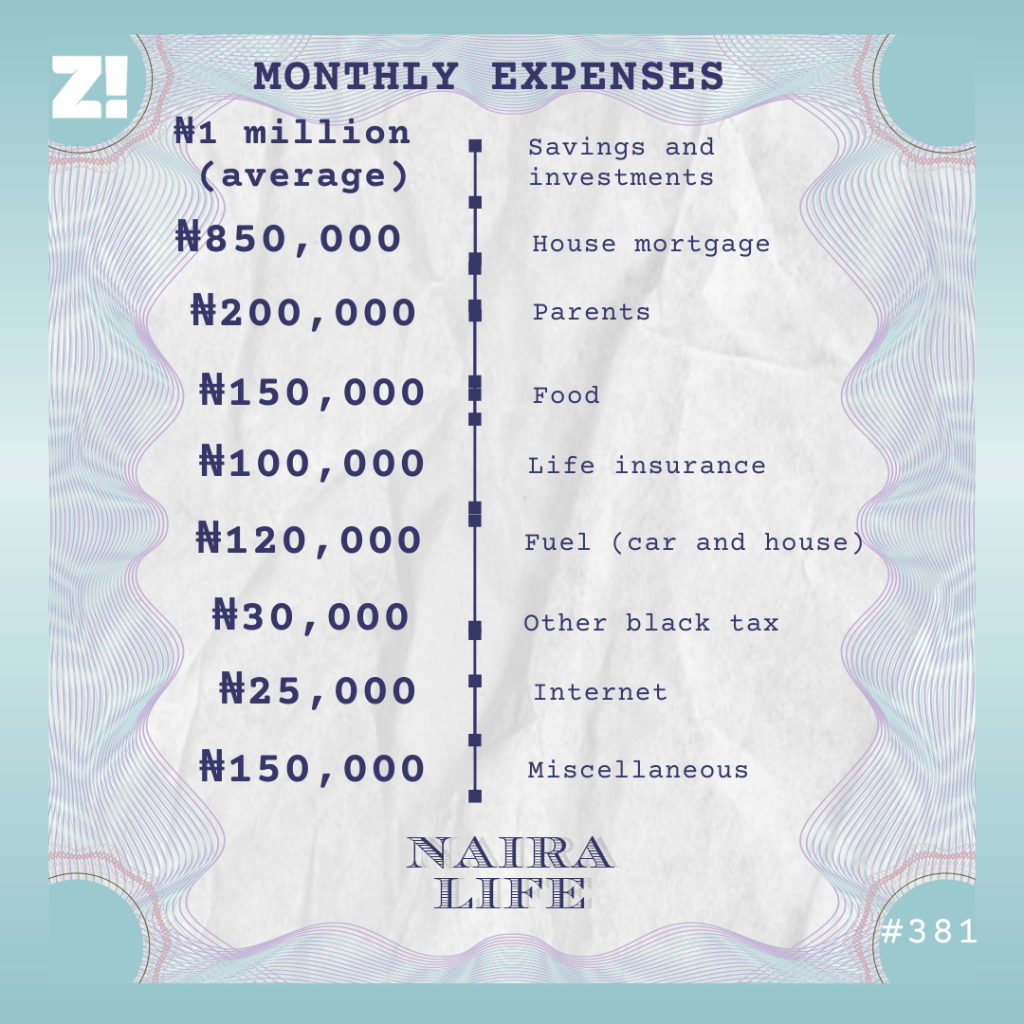
I try to be as frugal with money as possible. 50% – 60% of my income goes to my savings and investments, then I figure out the rest. My relationship with money is highly mature and healthy. I’m the guy my friends come to when they need financial or investment advice. I don’t live as large as I can actually live, but I still live a very okay life.
I’m curious about this ₦850k mortgage. How does it work?
At the end of last year, I signed a contract with a property development company for a house that requires a structured two-year payment plan ending in December 2027. Once I finish paying, I own it completely.
The payment plan is flexible because you don’t need to pay every month. As long as you pay everything before the scheduled end date, you’re good. So, instead of hand-delivering ₦850k to them every month, my financial strategy is to keep the money in a conservative mutual fund.
It accrues interest and generates passive income for me each month. Right before the final payment deadline next year, I will liquidate it and pay them off in one single lump sum. I don’t even know if I’ll move into the house yet; I just wanted the asset.
Interesting. What does the rest of your investment portfolio look like?
It’s pretty broad. To break it down:
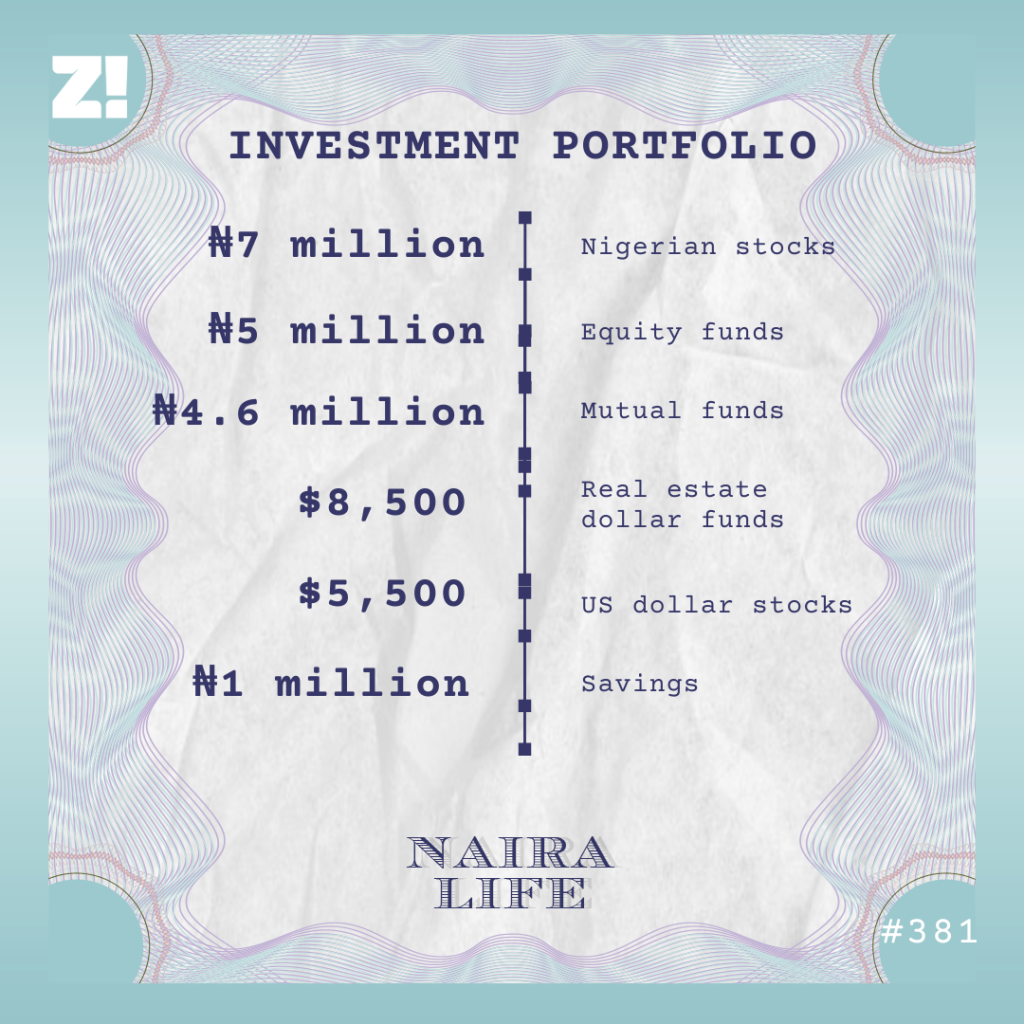
I also heavily invested in agriculture and land banking between 2025 and early 2026. I bought three separate one-acre plots of land managed by different agricultural companies: a palm oil plantation (cost me ₦4 million), a cassava farm (₦3 million), and a plantain farm (₦3.5 million).
The cassava and plantain will yield produce by next harvest season, while the palm oil is a long-term play that won’t earn until five years from now. I also bought a ₦12 million plot of land in Ogun State, where I plan to build, and a ₦3 million plot in Ibadan strictly for land banking. I bought both in 2024.
What is the ultimate goal for all these assets?
I want to build generational wealth. There wasn’t exactly anything wrong with my childhood, but I always wanted more. Coming from a poor background and being around rich kids all day highlighted the fact that, as much as I had the basics, there were also a lot of things that I didn’t have. I don’t want anybody coming after me to feel that way.
Also, I want to have enough passive income so I don’t have to work in retirement. I would love to retire between the ages of 45 and 50. By then, I hope to have a portfolio worth millions of dollars.
Have you considered what you need to do to get there?
I don’t want to worry too much about that. Maybe it’s because I’ve freelanced for so long, but my approach to life recently has been just winging it.
I’ve realised that worrying so much about how you want to get things done isn’t really necessary. What scares me the most is how you know you can keep hustling in life, and in the blink of an eye, everything is gone. One could fall sick, die, or anything could happen. Life is fragile.
So while I have big targets, I’m mostly winging it day by day. I don’t stress over career milestones or the “next big thing� anymore. I focus heavily on the present. Even the generational wealth I’m chasing is not for me. I just want to lay the foundation for those who come after me.
Is there anything you want right now but can’t afford?
A second passport. We all know how terrible Nigeria’s passport has gotten. I want to be able to travel and see the world freely without worrying about access and budgets or anything really.
Is there an ideal amount you think you should be earning monthly now?
₦10 million. I mean, my gross income sometimes gets around there, but then I have to pay my team’s salaries. There’s so much I’d be able to do if I can steadily net ₦10 million monthly.
How would you rate your financial happiness on a scale of 1-10?
5. I feel like there’s so much more I should be doing. I made a lot of terrible financial decisions when I was younger. If I had started my investment journey much earlier, I would be way ahead of where I am today.
Out of curiosity, do you see yourself freelancing for much longer?
Freelancing has been incredibly good to me, and unlike many others, I have never experienced a dry spell. But I know it won’t be sustainable forever, and I think it’s part of the reason why I’m saving up and investing the way I am.
I don’t see myself freelancing forever, but I want to build a portfolio that can sustain me forever without having to actively work. I’m certain I never want to return to the 9-to-5 life, though. Waking up daily to grind at an office desk feels like a meaningless way to exist. We’re born to do much more than just go to the office every day and toil away.
If you’re interested in talking about your Naira Life story, this is a good place to start.
Find all the past Naira Life stories here.